ServicesCarpet Installation
Carpet Installation in Humble
We pull the old carpet, check what is underneath and lay new pad and carpet stretched tight wall to wall. You get a plain answer on pad, seam placement and cost before we start, and a soft floor that stays flat.
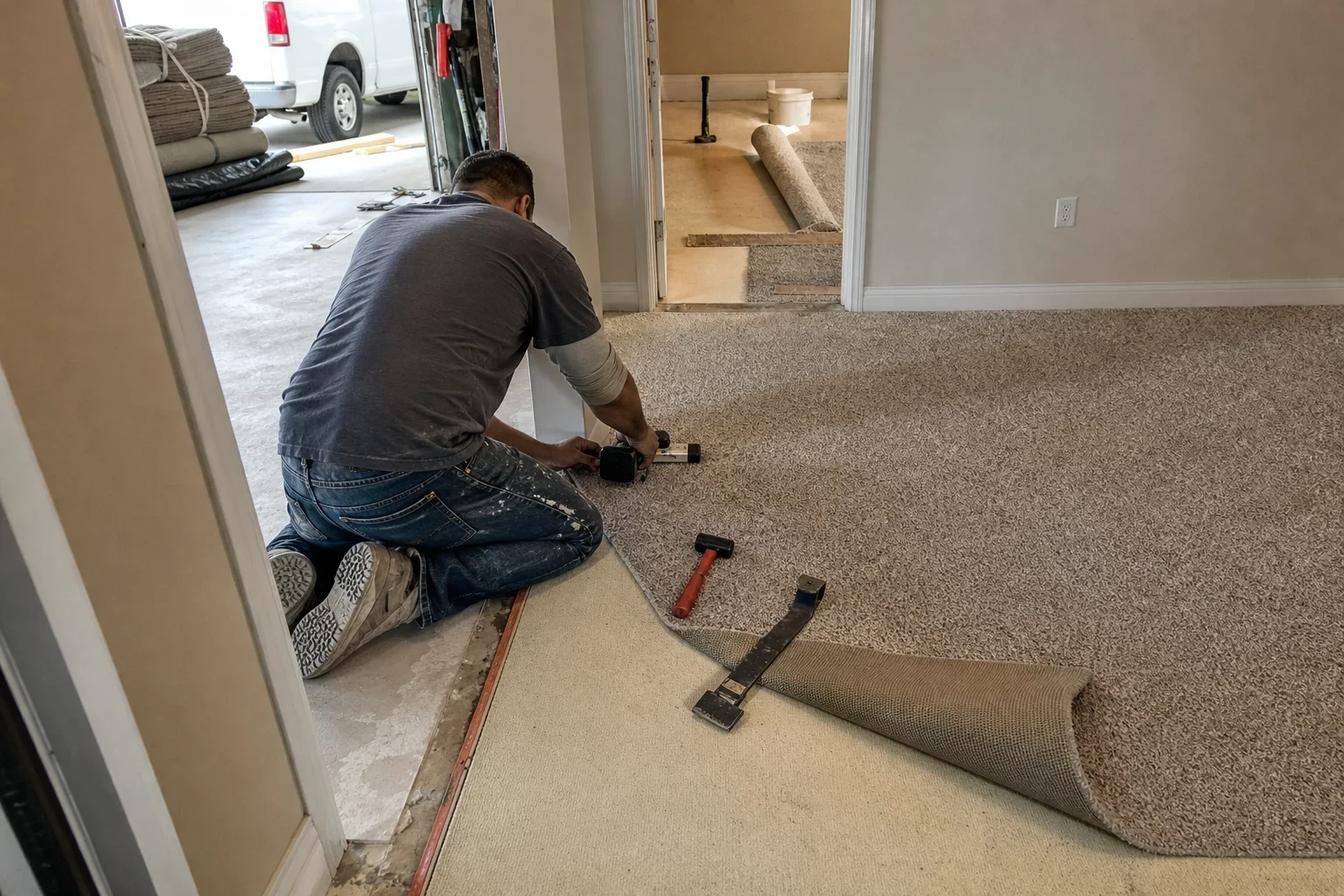
What Carpet Installation Covers
Carpet is still the warmest, quietest floor for bedrooms, game rooms and upstairs spaces. It is also the floor that fails fastest when it is put in wrong. Most of the problems people blame on cheap carpet are really install problems: a weak stretch, the wrong pad or seams in the wrong spot.
We handle the whole job. That means tear-out, pad, tack strip, stretching, seams, transitions to your other floors and cleanup. If you want a hard surface in some rooms instead, we can talk through luxury vinyl plank or laminate on the same call.
Many homes around Humble sit on concrete slabs, and slabs can push moisture up into a pad. We check for that first, so the carpet does not end up smelling musty a year from now.
What You Get With the Job
Old carpet out and gone
Every piece of old carpet, pad and staple comes up, and it all leaves on our truck. No dumpster to rent and no rolls left sitting at the curb.
Floor check under the old carpet
Once the floor is bare, we look for cracks, high spots and damp areas in the slab or soft spots in a wood subfloor. If something needs fixing, we show you and tell you what it adds before we go on.
Pad matched to the room
A dense pad holds up in hallways and family rooms. Over a slab, a pad with a moisture barrier keeps damp and odors out of the carpet.
Power-stretched carpet
We stretch every room with a power stretcher, not just a knee kicker. That tension is what keeps ripples from showing up after a few hot, humid summers.
Planned seams and clean transitions
Carpet comes in rolls about 12 feet wide, so larger rooms need seams. We put them out of main walkways and away from bright windows, and we finish edges where carpet meets tile or vinyl.
Coverage on the job and after
We are insured while working in your home. All installations come with a 1-year workmanship warranty.
Signs It Is Time for New Carpet
Ripples and bumps
Waves that come back after you smooth them mean the carpet has lost its stretch or the pad has broken down. Restretching sometimes buys time, but old carpet often just ripples again.
Worn paths you can see
Matted lanes down the hall and in front of the couch do not fluff back up. The fibers are crushed for good.
Smells that linger after a shampoo
When a pet mess or a spilled drink gets past the fibers, it ends up in the cushion below. A smell that creeps back days after a deep clean is coming from that layer. Cleaning the top will not reach it, so the pad has to be replaced.
Pad that has gone to dust
Fold back the carpet at the edge of a closet and see what is under it. Pad that is pressed thin, stiff or crumbling no longer cushions anything, and the carpet above it wears out early.
Open seams or frayed edges
Seams that split or edges pulling loose at doorways are trip hazards and only get worse with traffic.
How the Work Goes
- 1
Measure and talk it through
We measure each room and plan where the seams fall. You get a quote that lists carpet, pad, removal and any extra work separately.
- 2
Clear the rooms
We move standard furniture out of the way. Please empty dressers, closet floors and shelves and set aside anything fragile beforehand.
- 3
Tear out and prep
Old carpet and pad come up, and we pull staples and replace any loose or rotted tack strip. Floor problems get fixed before the new pad goes down.
- 4
Pad, stretch and seam
We lay the pad, roll out the carpet, power-stretch it onto the tack strip and seal the seams. Then we trim, tuck the edges and set transitions.
- 5
Clean up and walk through
We vacuum, haul off scraps and walk the rooms with you. Most homes are done in a day, larger jobs can take two.
What Moves the Price
Carpet cost is mostly the material, but the labor side changes more than people expect. Here are the things that push a quote up or down. We list each one on your quote, so nothing shows up later.
- Room size and roll waste
- Carpet is sold off rolls of fixed width. Odd room shapes, closets and the way seams line up can add extra yardage beyond the square footage.
- Carpet and pad grade
- Fiber type, density and pad thickness all change the price. A better pad under a mid-grade carpet often wears better than the reverse.
- Removal and floor repair
- Tearing out old carpet and pad is part of most jobs. Leveling a slab or replacing damaged subfloor is extra and only happens if the floor needs it.
- Stairs and furniture
- Each stair is wrapped by hand, so stairs cost more per foot than a room. Heavy items like pianos, gun safes or loaded bookcases also add time.
What People Ask About New Carpet
Something not covered here? (346) 253-1583
Is it okay to reuse the pad we already have?
In most cases, no. Pad that has been walked on for years is flattened and can trap smells or damp. Fresh carpet laid on top of it wears in lumps and low spots. The pad is a small share of the job cost, and new pad adds years to the carpet.
How long until we can use the rooms?
You can walk on the carpet as soon as we finish. Give it a day or two before dragging heavy furniture across it. A new-carpet smell is normal and fades with some airflow.
Will my doors still close?
Usually, yes. If new carpet and pad sit higher than the old floor, a door may drag. We will point that out and can trim the bottom of the door so it swings freely.
Do you carpet stairs too?
Yes. Stairs take more time and care than flat rooms, and we cover that work on our stair flooring page. We can quote stairs and rooms together on one call.
What if something goes wrong after you leave?
You are covered by our 1-year workmanship warranty on all installations. Should a seam pull apart or the carpet go slack during that first year because of how we put it in, give us a call. We come back out and make the repair.
Get a Straight Carpet Quote
Tell us the rooms and roughly how big they are. We will explain pad options, where seams would go and what drives your cost, then set a time to measure.